For a long time, a link-in-bio page was simple.
You had Instagram, TikTok, maybe a booking page, maybe a product link, maybe a contact form. You put all of them into one page, dropped the link into your bio, and called it done.
That worked when the goal was only to organize links.
But for many small businesses, creators, consultants, event hosts, beauty studios, coaches, and service providers, the bio link has quietly become something bigger. It is often the first page a potential customer sees after discovering you on social media.
And that creates a real problem.
If someone clicks your bio link and sees a plain list of buttons, they may not immediately understand what you offer, why it matters, what they should do next, or whether your business feels trustworthy.
That is why so many small business owners eventually ask the same question:
Is there something better than Linktree?
The answer is yes, but the better question is not "Which Linktree alternative is the prettiest?"
The better question is:
What should your link-in-bio page actually do for your business?
The real issue: most link-in-bio pages are too passive
A basic link list is useful, but it is not always persuasive.
It can show people where to go, but it usually does not guide them toward a decision.
For example, imagine someone finds your nail studio, fitness coaching page, handmade product shop, photography service, or workshop account on Instagram. They like what they see. They click your bio.
Then they land on a page with five buttons:
- Book now
- Services
- Contact
- Latest offer
Technically, the information is there.
But the experience still feels weak.
There is no clear story. No visual hierarchy. No sense of what is most important. No explanation of what makes your business different. No featured offer. No event details. No reason to act now.
This is where many small businesses lose potential customers. Not because the product is bad, but because the next step feels unclear.
A better bio link should not just collect links.
It should help visitors make a decision.
Why small businesses need more than a "pretty links page"
Aesthetic design matters, especially for industries where trust and taste are part of the product. A beauty studio, event host, photographer, coach, creator, or local brand cannot afford to look generic.
But "better looking" is only part of the problem.
The stronger version of a link-in-bio page should help with at least one of these goals:
- Explain what you offer quickly
- Highlight your most important call to action
- Showcase services, events, products, or offers visually
- Make booking, inquiry, RSVP, or purchase easier
- Build trust before someone contacts you
- Keep your social traffic from getting lost
If your current link-in-bio page is only a list of buttons, it may be enough for casual followers. But it may not be enough for visitors who are close to becoming customers.
That is the difference between a link directory and a small business landing page.
Option 1: Use a more visual link-in-bio builder
The simplest solution is to switch from a plain link list to a more visual link-in-bio tool.
This is a good choice if your main problem is presentation. Maybe your current page feels too plain, too template-like, or too disconnected from your brand.
A more visual bio page can help you:
- Add stronger branding
- Use images or cards instead of only buttons
- Highlight one main action
- Group links by purpose
- Make your page feel more polished on mobile
This works well for creators, influencers, personal brands, and small businesses that mainly need to organize content.
However, there is one limitation: many visual bio tools still treat the page as a collection of outbound links. The design may improve, but the page may still not function like a true business page.
So if you only need better design, this option may be enough.
If you need booking, RSVP, offers, service menus, event details, or customer inquiries, you may need something more structured.
Option 2: Use an interactive card instead of a basic bio link
For small businesses, an interactive card can be a better fit than a traditional link-in-bio page.
Instead of showing visitors a flat list of links, an interactive card gives them a focused mobile page built around one action: book, RSVP, contact, view services, explore an offer, join a waitlist, or learn more.
This is where a tool like CueCue can make sense.
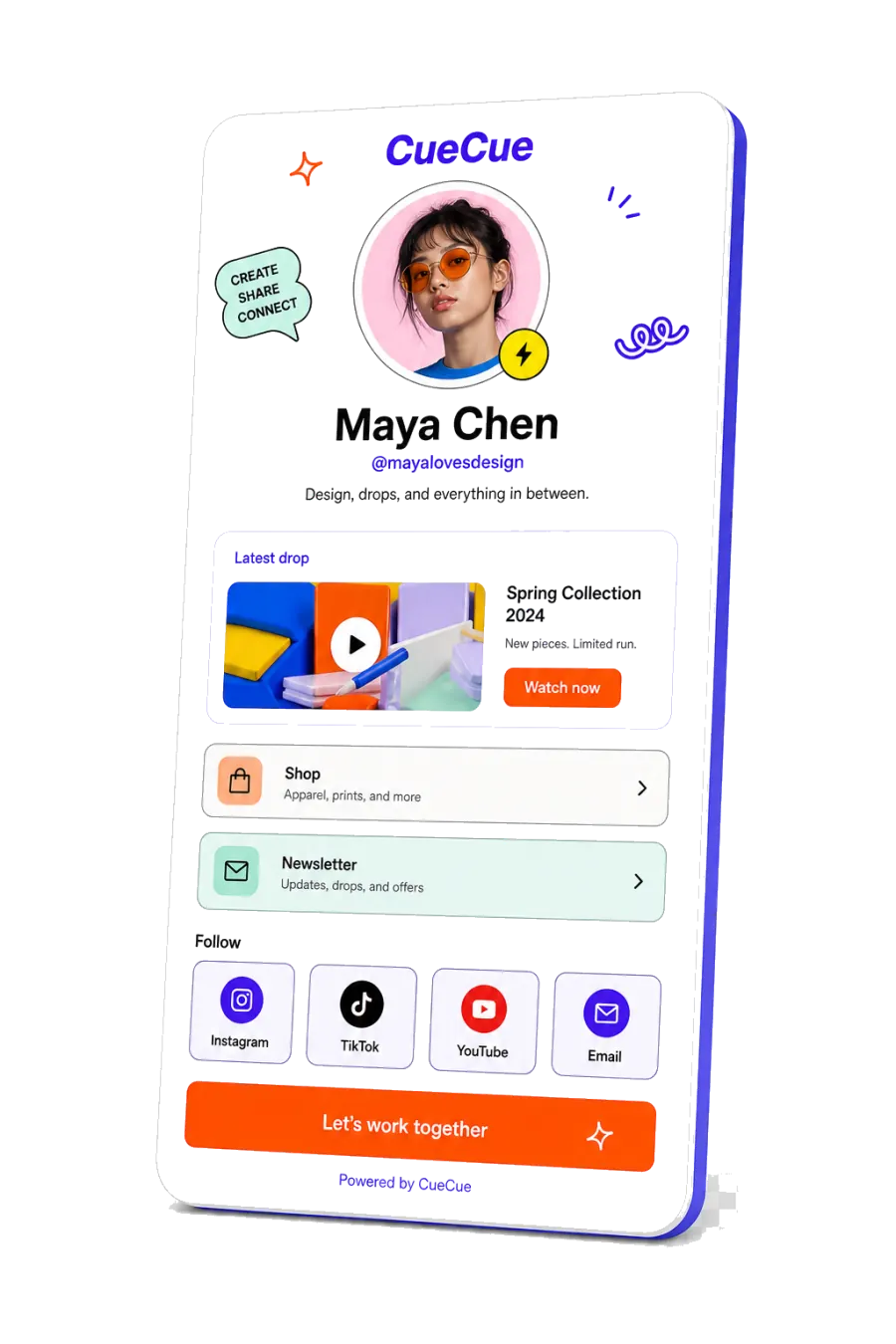
CueCue lets creators and businesses build interactive web cards for things like bio links, digital business cards, RSVP pages, event pages, product cards, service offers, and local business pages. The key difference is that the page does not have to feel like a simple link directory. It can feel more like a compact landing page.
Turn your bio link into your smallest business page. Build an interactive CueCue card that highlights one clear action and helps visitors decide — no coding, and mobile-ready in minutes. Create your CueCue card free
For example:
A beauty studio could use one card to show services, prices, new customer offers, booking information, and social links.
A workshop host could use one card to explain the event, show the date and location, collect RSVPs, and link to updates.
A creator could use one card to feature a new drop, newsletter, offer, video, and contact option.
A consultant or freelancer could use one card as a digital business card with intro, services, contact links, and a clear inquiry button.
This kind of structure is helpful because it matches how people actually make decisions.
They do not only need a link. They need context.
They want to know:
- "What is this?"
- "Is it for me?"
- "What do I do next?"
- "Can I trust this?"
- "How much effort will this take?"
A good interactive card answers those questions faster than a plain list of links.
CueCue is especially useful if your bio link needs to support different business moments, not just your profile. For example, you might need one page for your general bio, another for a seasonal offer, another for an event, and another for a specific service.
That flexibility matters for small businesses because your "main link" often changes depending on what you are promoting this week.
Option 3: Build a simple landing page
Another solution is to create a lightweight landing page using a website builder.
This can work well if you want more control over layout, copy, SEO, analytics, and branding. A custom landing page can look professional and give you room to explain your business in detail.
This is a strong option if you have:
- A clear service package
- A product launch
- A paid offer
- A local business with multiple services
- A need for search traffic from Google
- A more complex customer journey
But it also comes with more work.
You may need to choose a template, write all the copy, set up mobile responsiveness, connect forms, adjust SEO settings, test loading speed, and update the page whenever your offer changes.
For some businesses, that is worth it.
For others, it is too much friction for something that started as "I just need a better link in bio."
So a landing page is best when you are ready to treat the page as a serious marketing asset, not just a social profile add-on.
Option 4: Use your booking or commerce platform as the main link
Some businesses do not need a separate bio link tool at all. They may be better off sending visitors directly to a booking page, online store, event platform, or inquiry form.
For example:
A salon may link directly to its booking system.
A coach may link directly to a consultation form.
A shop may link directly to a product collection.
An event organizer may link directly to an RSVP or ticketing page.
This approach reduces steps. If the visitor already knows what they want, sending them straight to the action can improve conversion.
But it can also be too abrupt.
If someone is still deciding, a direct booking page may not provide enough context. They may want to see your offer, style, pricing, photos, reviews, location, or event details before committing.
So this option works best when your audience already has strong intent.
If your visitors are coming from social discovery, they may need a softer bridge between "I just found you" and "I am ready to book."
Option 5: Keep Linktree, but redesign the strategy
Sometimes the tool is not the only problem.
The structure is.
If you are not ready to switch tools, you can still improve your current link-in-bio page by making it more intentional.
Start by removing links that do not support your current goal.
Then choose one primary action.
For example:
- Book a service
- RSVP to an event
- View the latest offer
- Join the newsletter
- Send an inquiry
- Shop the new collection
Make that action the most visible item on the page.
Then group the rest of your links into categories. Do not make visitors scan ten equal-looking buttons and guess what matters.
You can also rewrite your button labels to be more specific.
Instead of "Services," try "View nail services & pricing." Instead of "Contact," try "Ask about custom orders." Instead of "Event," try "RSVP for Saturday's workshop."
Small wording changes can make the page feel more useful and less generic.
How to choose the right Linktree alternative
Before choosing a tool, ask what your bio link is supposed to accomplish.
If you mainly need a clean list of links, a simple bio link builder may be enough.
If you care most about visual style, choose a tool with stronger design customization.
If you need people to book, RSVP, inquire, or understand an offer, consider an interactive card or mini landing page.
If you want SEO traffic and long-form explanation, build a full landing page.
If your audience already has high intent, send them directly to your booking or purchase page.
The best choice depends on your business model.
But the main principle is the same:
Your bio link should not make people think too hard. It should make the next step obvious.
A better bio link feels like a destination, not a detour
The problem with many link-in-bio pages is not that they are ugly. It is that they feel unfinished.
They act like a hallway instead of a room.
Visitors click in, see several doors, and have to decide where to go next. That may work for a large creator with loyal fans. But for a small business trying to convert new visitors, it can create unnecessary friction.
A better page should feel like a destination.
It should tell people who you are, what you offer, why they should care, and what to do next.
That does not always require a full website. In many cases, a focused mobile page, interactive card, or better-structured bio link is enough.
The key is to stop thinking of your bio link as a storage place for links.
Think of it as your smallest business page.
Because for many visitors, that is exactly what it is.
About this content
- Written by
- Luhao Zhao, Growth product marketer and founder of EasyGlobe Growth
- Last updated
- June 3, 2026
- Editorial standard
- CueCue articles are written for practical use, checked for clear sourcing, and updated when product or policy details change.