
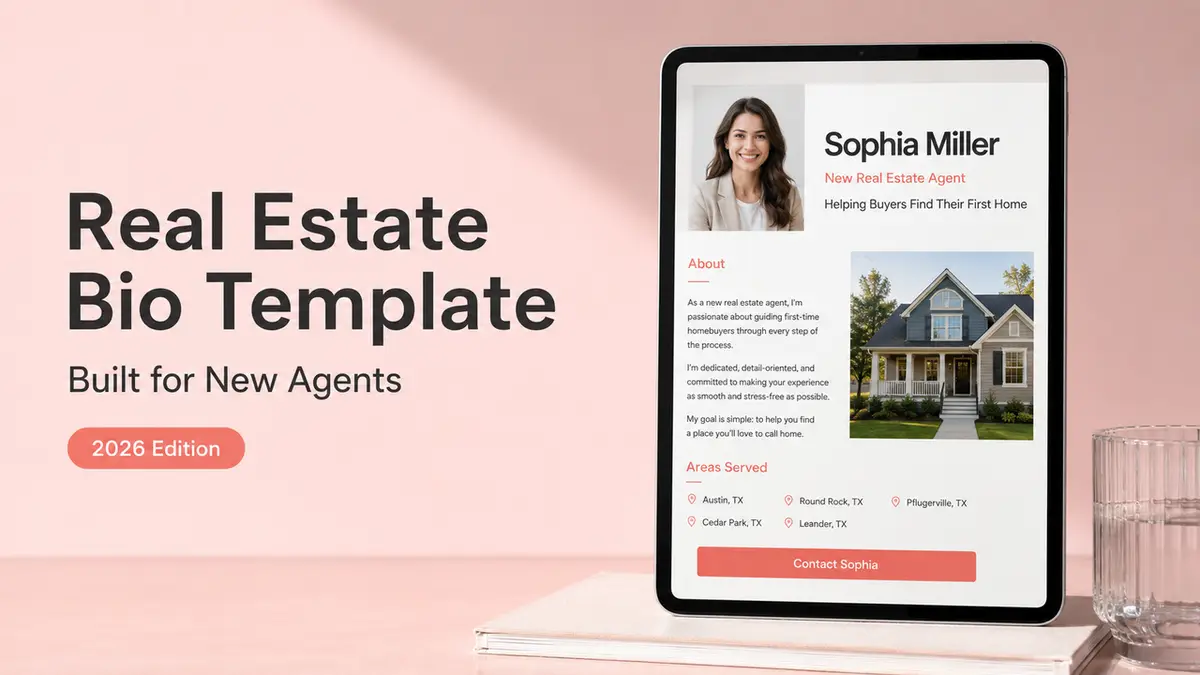
The first version of your bio may feel strangely high-stakes. You have a license, a brokerage, and a real reason to help people, but no decade of sales numbers to stack beneath your name.
That's the real reason a new agent bio shouldn't try to sound more seasoned than you actually are. The case you're making needs to be smaller and easier to believe — you know the area, you take this seriously, and there's a clear way to reach you.
I am Mia, and I learned this while rebuilding my own creator profile. I kept adding proof until the page got busy and the next step disappeared. Once I put one clear action near the top, the profile made sense again.
What a new real estate agent bio template needs to prove
Your bio does not need hundreds of transactions behind it. It needs to answer the quieter questions a prospect is already asking:
Do you know my area? Will you communicate clearly? Are you working inside a legitimate brokerage? What should I do next?
Trust comes from specifics. Name your service area, your client focus, and relevant experience from earlier work, such as negotiation, project management, construction, hospitality, or customer service.
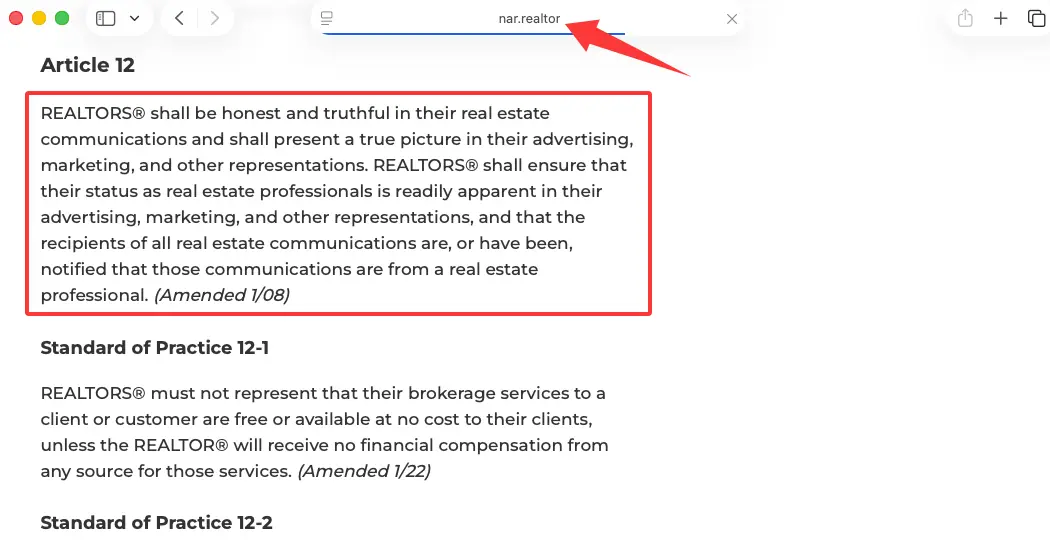
Keep every claim supportable. The FTC says advertising must be truthful, non-deceptive, and supported by evidence when evidence is required. That principle applies to profile claims about rankings, volume, expertise, and results too. Review the FTC advertising guidance for small businesses before publishing claims you cannot document. If you're a REALTOR®, Article 12 of the NAR Code of Ethics is pretty direct about this: your advertising and other representations need to paint a true picture. On top of that, your brokerage, state commission, local association, and MLS each tend to have their own rules — things like license details, brokerage identification, team names, listing disclosures. Worth checking before you publish anything. Check those rules before publishing. Read the 2026 NAR Code of Ethics.
A simple new real estate agent bio template
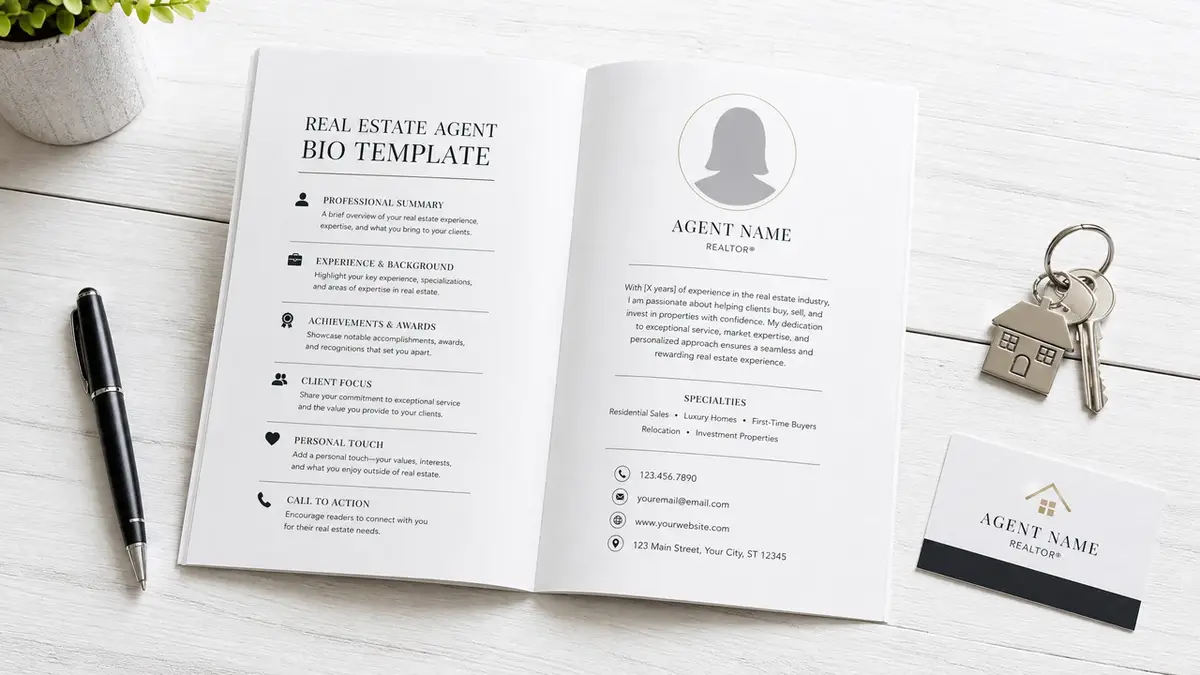
Treat this as a starting point, not a finished bio. Swap out every bracket for something you'd actually say out loud.
[Name] is a real estate agent with [Brokerage], serving [city, neighborhood, county, or region]. [He/She/They] works with [specific client type], with a focus on [property type, life stage, or local niche].
Before entering real estate, [Name] worked in [relevant field or role], where [he/she/they] developed strengths in [one or two useful skills]. That background now helps clients [practical benefit, without promising an outcome].
[Name] is known for [honest working style], clear communication, and a practical approach to each step of the process. For help with [buying, selling, relocating, or another service within your scope], [single contact action].
That is enough for a strong first version.
Local focus and service area
“Serving everyone” sounds generous, but it gives the reader nothing to hold onto.
Name the city, county, or group of neighborhoods you genuinely know and are permitted to serve. Add one grounded detail. Maybe that's working with first-time buyers along a commuter corridor. Maybe it's helping sellers get older homes in one particular district ready to list. Or it could be relocations into an area you actually know well.
Skip language that implies expertise you haven't earned yet. Something like "I'm building my practice around waterfront communities" holds up a lot better than claiming a specialty you don't actually have yet.
A useful sentence pattern is:
I serve buyers and sellers across [area], with a growing focus on [niche] and the practical details that matter in this market.
Credibility without overclaiming experience

New agents sometimes hide the word “new” and compensate with foggy phrases such as “unmatched market expertise.” That does not create proof. It creates suspicion.
Use real credentials and relevant context instead. Mention your active license, brokerage affiliation, completed training, professional designations you actually hold, languages spoken, local roots, or transferable experience.
You may also explain how your brokerage or team supports clients, but do not present the group’s transaction history as your personal production.
Be careful with “top,” “number one,” “award-winning,” and “expert.” Any ranking or team result needs accurate, visible context.
Plain language feels stronger:
I am a newly licensed agent backed by the resources of [Brokerage], and I bring six years of client service experience to every conversation.
No smoke machine required.
Clear next step for buyers or sellers
End the bio before it becomes a life story. Then point somewhere.
Pick one primary action based on the prospect you most want to help now. That might be “Request a buyer consultation,” “Ask about selling your home,” or “View current listings.”
Do not give equal visual weight to six buttons.
For a short new real estate agent bio, your final line could be:
Planning a move in [area]? Request a 15-minute introduction call with [Name].
How to connect the bio to an inquiry page
Your bio earns interest. The inquiry page gives that interest somewhere useful to go.
Keep the name, brokerage, service area, and promise consistent on the inquiry page — don't introduce new framing there. And only ask for information you'll actually use: a buyer form really just needs a name, email, preferred area, and timeline. A seller form may add the property address.
CueCue can serve as the implementation layer here. Its official pages describe real estate digital cards with an agent profile, listing links, testimonials, phone contact, QR sharing, forms, booking links, and lead capture. Paid plans also mention analytics. Those features can support a focused agent profile or inquiry page without requiring a full website. See CueCue’s digital business card examples.

Be careful when adding listings to your profile or inquiry page. Link only to listings you are authorized to advertise, and follow your MLS, brokerage, copyright, attribution, and local advertising rules. NAR guidance notes that REALTORS® may need permission before marketing another broker’s listing on social media or other websites. Review NAR guidance on displaying another broker’s listings. A prospect should not have to hunt for the contact path after deciding they trust you.
Mistakes that make a new real estate agent bio template feel generic
The most common problem is borrowed language. “Passionate about helping clients achieve their real estate dreams” could belong to anyone, which means it tells the reader almost nothing about you.
Replace broad sentiment with one useful detail. Say who you help, where you work, how you communicate, or what previous experience shapes your approach.
Third person is fine, especially on a brokerage page. The test is whether the language still sounds human.
Watch for these problems:
- A long personal history before the reader learns your service area
- Team sales numbers presented as individual production
- Neighborhood claims that drift beyond your real knowledge
- Testimonials, designations, or awards without permission or context
- Several competing calls to action
- Brokerage or license information missing where local rules require it
Your bio should feel specific enough that another agent could not paste in their name and keep every sentence.
A new real estate agent bio template gives you a safe structure, but the trust comes from details you can stand behind. Your one move today: replace the brackets with your real service area, brokerage, relevant background, and one contact action.
FAQ
Should new agents mention they are new?
You can, but you do not need to make “new agent” the headline.
A direct line works: “I am a newly licensed agent with [Brokerage], bringing [relevant background] to my work with [client type].”
Ask your broker how new-license status and team support should be described in your market.
Can a new agent bio link to a lead form?
It can. Explain what happens after submission:
Share your timeline and preferred area, and I will follow up to schedule an introductory call.
Do not collect sensitive financial information in a basic contact form. Use brokerage-approved systems and processes for information requiring stronger protection.
How often should new agents update their bio?
Update it whenever a material fact changes: your brokerage, service area, contact method, designation, niche, team structure, or primary CTA.
A quarterly read-through is sensible during your first year. Remove old claims rather than layering new sentences on top.
About this content
- Written by
- Mia Anderson, UGC Creator · Content Creator
- Reviewed by
- CueCue Team, Editorial review desk
- Last updated
- June 30, 2026
- Editorial standard
- CueCue articles are written for practical use, checked for clear sourcing, and updated when product or policy details change.