

A new agent bio can feel like a room with nowhere to hide.
You cannot lean on ten years of transactions. You may not have client testimonials yet. And every sample online seems to begin with some version of “top-producing local expert,” which is not useful when you are still building your first year.
The strongest real estate bio examples for new agents do something more honest. They choose one credible trust signal, explain it clearly, and give the reader an obvious next step.
That trust signal might be neighborhood knowledge. It could come from a previous career, a focused client type, or the support of a brokerage. You do not need all of them at once.
You need one angle you can stand behind.
What makes real estate bio examples for new agents useful
A useful example shows you how a real fact can become a reason to contact you.
It should not simply sound polished. It should help a prospect understand why your background matters in a home search, sale, or relocation.
That usually means the example contains four things:
- A defined service area or client type
- A credible source of experience
- A clear description of how the agent works
- One practical contact action

The proof does not need to be dramatic. In fact, smaller details are often more believable.
“Based in North Austin and focused on first-time buyers” tells me more than “committed to exceptional service.” One gives me a place and a person. The other could sit on almost any agent profile.
There is a separate job for structure. Our new real estate agent bio template explains how to organize the full bio from opening line to CTA. The examples below focus on the angle itself, so you can see how different kinds of trust sound on the page.
Example angles by trust signal
No need to copy these word for word.
What you're really looking for in each one is the logic underneath: which fact is doing the trust-building, who it's speaking to, and what it's asking the reader to actually do next.
Local neighborhood focus
Local knowledge only helps if it's specific enough that someone can actually act on it.
If your real familiarity is a few neighborhoods, a school district, or a relocation route you've driven a hundred times, don't dress that up as mastery of the whole metro.

Example:
Jordan Lee is a real estate agent with [Brokerage], working with buyers and sellers across Cedar Park, Leander, and northwest Austin. Seven years living in the area means Jordan's picked up on the questions that actually shape a move — commute patterns, how neighborhoods are laid out, how fast new construction is moving through.
The clients Jordan works best with want a process that's organized and communication that doesn't require chasing. Thinking about a move in northwest Austin? Request an introductory call and talk through your timeline.
Why this works:
The example does not claim to be the area’s leading expert. It uses residence, service area, and practical familiarity as the trust signal.
The CTA also matches the stage of the reader. It asks for a conversation, not an immediate commitment.
A local angle becomes stronger when you replace broad statements with things you genuinely know. Think housing styles, transit routes, the relocation questions people actually ask, or just how the different neighborhoods fit into daily life.
Keep it factual. Skip sweeping claims such as “I know every corner of the city.”
Career-change background
A previous career is not filler. It can explain how you communicate, solve problems, or manage a complicated process.
The useful part is not the old job title by itself. It is the skill that carries into real estate.
Example:
Before real estate, Priya Shah spent eight years in project coordination — juggling deadlines, vendor communication, and the kind of detailed requests that don't leave room for dropped balls. That same organized approach now carries over to the buyers and sellers she works with across [service area] as an agent with [Brokerage].
Priya is especially comfortable helping clients who want each step explained without pressure or jargon. For questions about buying or selling in [area], send Priya a short note with your timeline and the kind of move you are considering.
This is a stronger new realtor biography sample than a vague promise about hard work because it connects the old career to a visible client benefit.
A teacher might talk about explaining complicated information clearly. A hospitality professional could point to responsiveness and calm communication. Someone from construction may understand project sequencing, but should be careful not to imply inspection, appraisal, or contractor expertise they do not hold.
Use the transferable skill. Leave the inflated title in the attic.
Buyer or seller specialization
A new agent can choose a focus without pretending to have a long record in it.
The safest language shows intention and current practice rather than unsupported dominance. Phrases such as “works with,” “is building a practice around,” or “has a particular interest in” are usually more grounded than “specializes in” when the experience is still developing.
Buyer-focused example:
Mateo Rivera is a newly licensed agent with [Brokerage], working with first-time buyers in [service area]. His focus is the early stage of the process — helping people get their questions in order, weigh priorities, and know roughly what to expect before they ever start touring homes.
Mateo brings a patient, no-rush approach to each conversation. First-time buyer in [area]? Use the inquiry form to share your preferred neighborhoods and approximate timeline.
Seller-focused example:
Erin Brooks is a real estate agent with [Brokerage], working with homeowners in [service area]. Her practice centers on the decisions sellers face before a property even goes on the market — getting priorities sorted and understanding what the brokerage team needs from them next.
Thinking about selling in the next six to twelve months? Request a short planning call with Erin.
Neither example claims completed sales, premium results, or advanced expertise.
The trust comes from clarity. The reader can immediately see who the agent hopes to help and what the first conversation will cover.
How to adapt real estate bio examples for new agents without copying
Copying an example usually creates a strange little costume. The words fit grammatically, but they do not sound attached to a real person.
Start by identifying the trust signal beneath the sample.
For the neighborhood example, the trust signal is lived familiarity. For the career-change example, it is transferable experience. For the niche example, it is a focused client and a clearly described process.
Then rewrite the example using facts from your own work.A simple adaptation process looks like this:
- Circle every claim in the sample.
- Replace each claim with something you can verify.
- Remove any sentence that could belong to almost every agent.
- Match the CTA to the client you are trying to attract.
You can also read the broader real estate bio guide for guidance on tone, length, placement, and profile-page context.
Do not preserve a sentence simply because it sounds impressive. Keep it only when it is true and useful.
Risks: fake proof, weak CTA, and compliance issues
The fastest way to weaken a new agent bio is to borrow proof you did not earn.
That includes team transaction totals presented as personal production, awards without context, invented testimonials, unsupported rankings, and vague claims of market leadership.
The FTC states that advertising claims must be truthful, non-deceptive, and supported by evidence where substantiation is required. That principle applies to objective claims about results, rankings, experience, and performance. Review the FTC’s advertising guidance for small businesses.
For agents who are REALTORS®, Article 12 of the 2026 NAR Code of Ethics requires honesty and a true picture in advertising, marketing, and other representations. On top of that, brokerage policies, state commission rules, local associations, and MLS requirements can each layer on their own rules — license details, brokerage identification, team names, how listings get promoted, disclosures. Worth reading through the 2026 NAR Code of Ethics before you publish.
A weak CTA causes a different problem. The bio builds interest, then leaves the reader staring at a phone number, five social icons, and a listings button with no guidance.
Pick one next action.
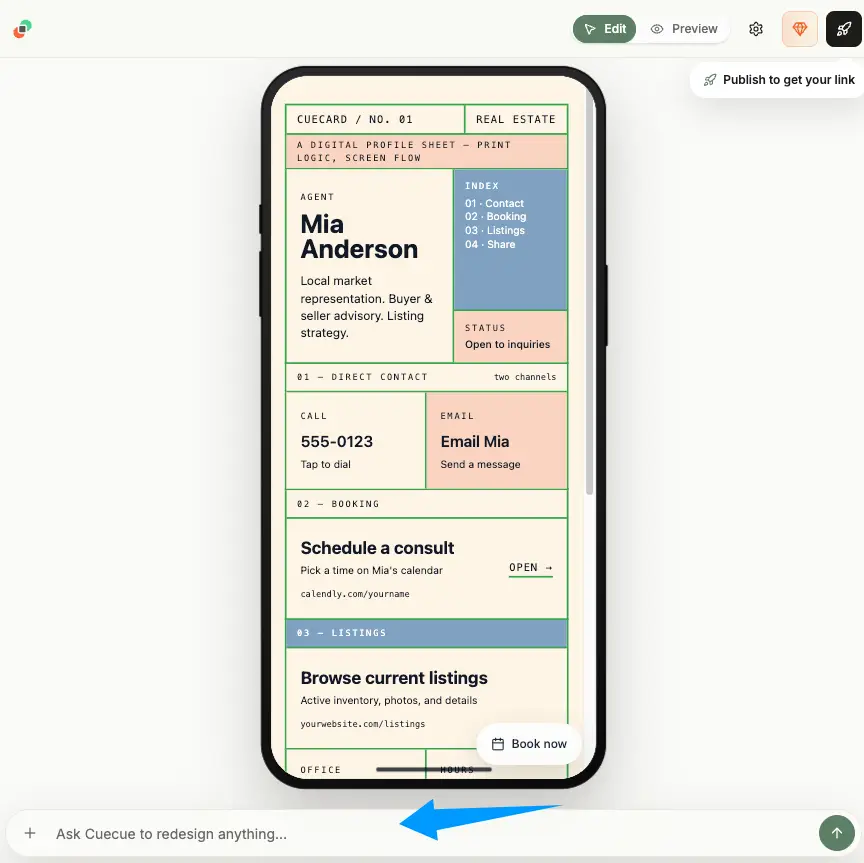
CueCue can support that handoff with a focused digital card containing an agent profile, contact options, a listings link, booking, forms, QR sharing, and a clear follow-up action. Its official site also describes real estate card templates and lead-capture modules. See CueCue’s digital business card workflow.
Use only the modules you actually need. A buyer-focused bio might lead to a short inquiry form. An open-house profile might use a QR code and contact action. No full website needed.

The best real estate bio examples for new agents do not hide the early stage of the career. They make the available proof easier to understand.
Choose one trust signal from this article, then rewrite one example using only facts you could comfortably explain to a broker or prospect.
FAQ
Can new agents use client-free examples?
Yes. An example does not need a past client story to feel credible. Use verifiable details such as your service area, brokerage affiliation, prior career, language skills, completed designations, local involvement, or the type of client process you are prepared to support.
Label hypothetical wording as a sample. Do not turn it into a testimonial or implied result.
Should new agents include brokerage names?
Usually, yes, but the exact display requirements depend on your brokerage and local rules.
Your brokerage name can strengthen trust by showing where you are affiliated and how your work is supervised. Ask your broker how the company name, logo, team name, license information, and contact details must appear on public profiles.
Do that before publishing, not after the compliance email arrives.
What proof can new agents use safely?
Use proof that is accurate, current, and easy to verify.
Think active license, brokerage relationship, a designation you actually hold, relevant work history, language ability, community involvement, or just genuine familiarity with the area you serve.
Be precise about what the proof establishes. Living in a neighborhood may support local familiarity. It does not automatically prove sales expertise, transaction volume, or pricing performance.
About this content
- Written by
- Mia Anderson, UGC Creator · Content Creator
- Reviewed by
- CueCue Team, Editorial review desk
- Last updated
- June 30, 2026
- Editorial standard
- CueCue articles are written for practical use, checked for clear sourcing, and updated when product or policy details change.