
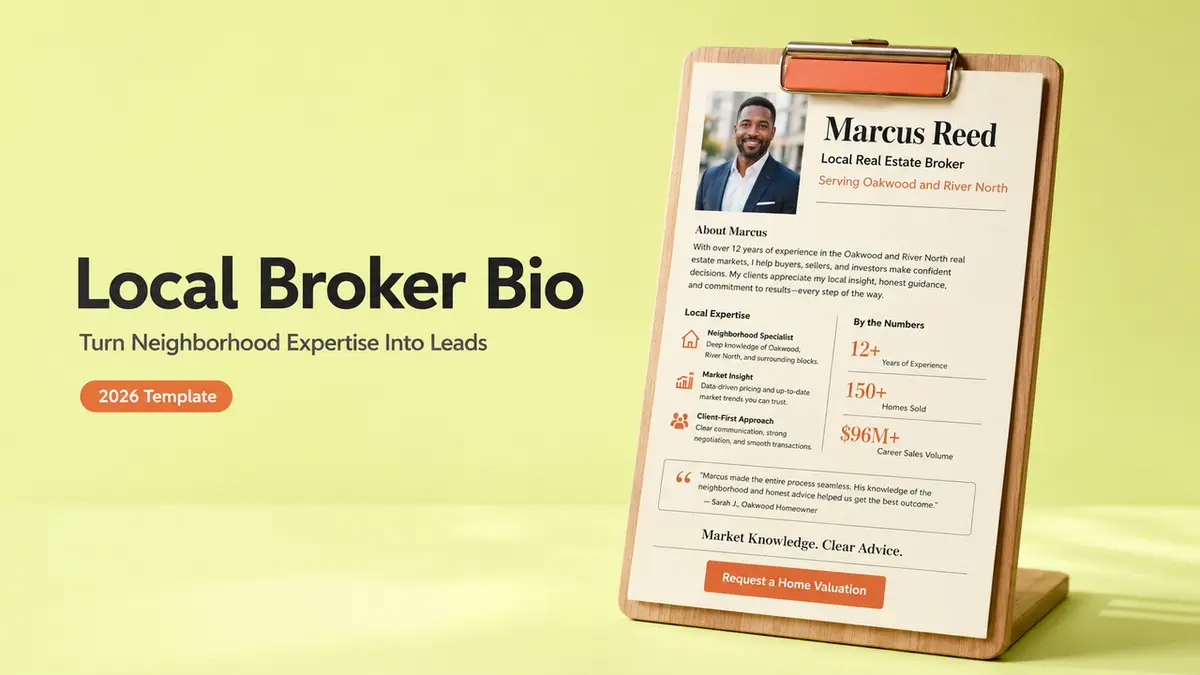
The most useful profile I ever shared sat behind a QR sticker on my laptop lid. People saw my name, understood what I did, and had one obvious way to contact me.
A real estate broker bio needs that same clarity, with more context behind it. Local prospects may be evaluating your market knowledge, services, and brokerage. They should not have to guess whether you handle clients directly or lead a team.
Your biography should make the role understandable. Then it should give interested people somewhere useful to go.
How a real estate broker bio differs from an agent bio
An agent bio usually stays close to one person’s client work: who they serve, where they work, and what the buying or selling experience looks like with them.
A broker bio may also need to explain ownership, management, supervision, and direct client work, while the public description still has to match the broker’s actual duties under state licensing rules. NAR’s guidance for people establishing a brokerage distinguishes agents working under a licensed broker from brokerage owners.

That difference changes the writing. A generic line about being “passionate about real estate” does little to explain who handles an inquiry or what the brokerage is known for.
Try a plainer sentence:
As the managing broker of [Brokerage], [Name] oversees [team or office responsibility] and works directly with [specific client group] across [service area].
Only include the parts that are true. Short is fine. Foggy is not.
What local prospects need from a real estate broker bio
A local prospect often wants reassurance before calling. They need to know whether you understand the market, whether your services fit, and what kind of response they will receive.
That is the quiet job of the page.
Market focus
“Local expert” is easy to type and hard to prove. Give the phrase some ground under its feet.
Name the places where the brokerage regularly works. That might be one city, several nearby communities, a county, or a defined metro area. Then add one detail that shows how you think about that market: property types, common transaction timelines, inventory patterns, or decisions clients often face there.
For example:
[Name] works with homeowners and buyers across [City] and nearby [communities], with a focus on [property type or client situation]. Her local guidance is shaped by [verified experience or specific working knowledge].
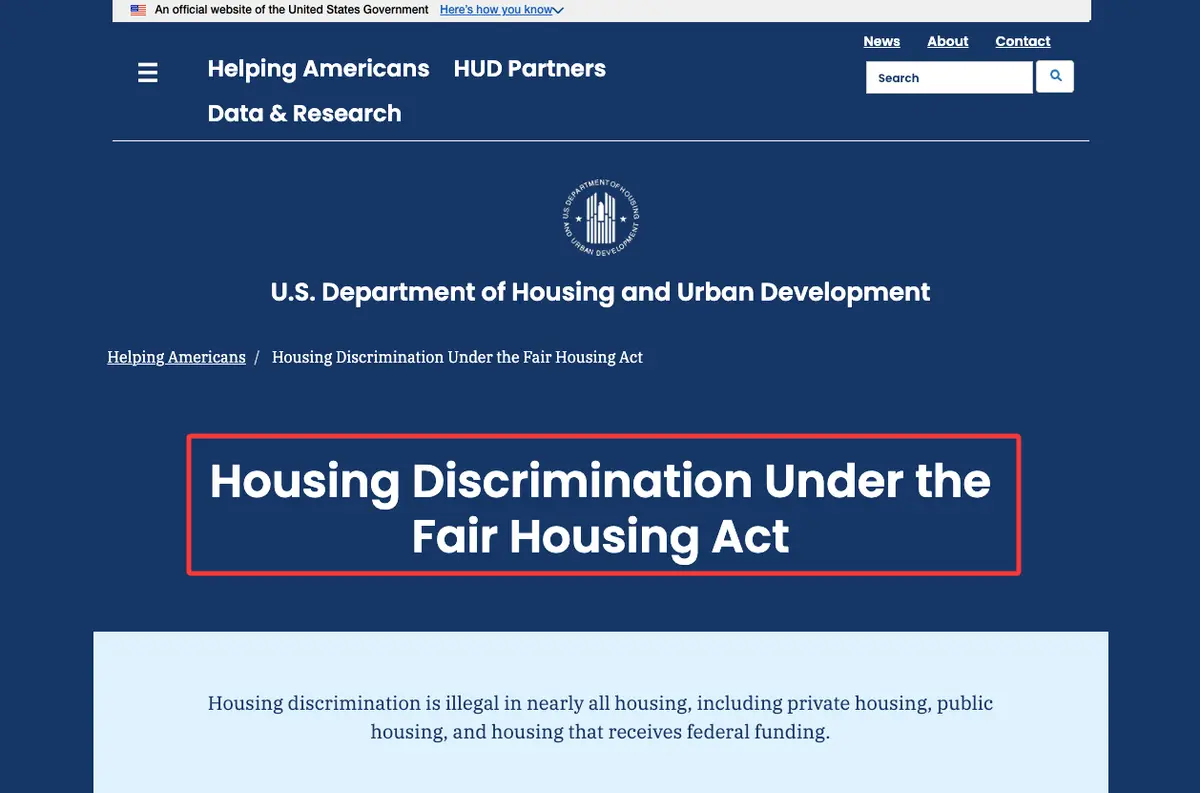
Keep neighborhood language focused on housing facts and client needs. The Fair Housing Act overview from HUD is a useful checkpoint when reviewing public-facing real estate copy, alongside state and brokerage requirements.
Services and team role
Broker bios become confusing when they try to make one person sound like the entire company. A reader may see a long service list but still have no idea who will return the call.
State the broker’s role first. Then explain how the team fits around it.
A broker who personally handles listings can say so. A managing broker who routes new inquiries to specialists should make that process visible. When team members have separate areas of focus, name those areas rather than presenting everyone as interchangeable.
[Name] leads [Brokerage] and oversees [relevant responsibility]. Buyer inquiries are handled by [person or team], while [Name] works directly with [verified focus].
A team section can help, but it should not become a wall of headshots. Give each person a role and contact path. CueCue templates can be adapted for team profiles, keeping the brokerage identity consistent while giving each person a clear place in the inquiry flow.
Contact or consultation path
“Contact us” leaves too much undecided. The reader has to guess what to say and whether the conversation is meant for them.
Give the first conversation a name. A seller might request a property planning call, while a buyer could ask for a local search consultation. Owners considering a brokerage change may need a separate recruiting conversation.
Pick the action that matches the page, then tell people what information will help you respond.
Thinking about selling in [service area]? Share the property location and your preferred timing, and [Name or team] will follow up about the right first conversation.
No grand promise. Just a clear handoff.
How to turn a real estate broker bio into a lead path
A biography can earn attention and still lose the inquiry at the bottom of the page. This happens when the contact path is scattered across a phone number, a general inbox, several profiles, and an unlabeled calendar link.
Bring those pieces into one short route so the real estate biography works as a focused lead capture page.
Start with the broker’s positioning. Add the service area and role. Show only the proof a local prospect needs at this stage, then place one main action close to it. Supporting links can sit lower on the page.
A CueCue digital business card can hold a broker profile, brokerage details, a listings link, testimonials, contact actions, booking, and QR sharing. Its real estate example includes a profile, listings link, phone, testimonials, and open-house QR use.
For leads that need sorting before a call, connect the main button to a short client intake and booking card. CueCue forms can collect area, timing, service type, and preferred follow-up details before routing someone to a consultation or a manual reply inside the same lead path.
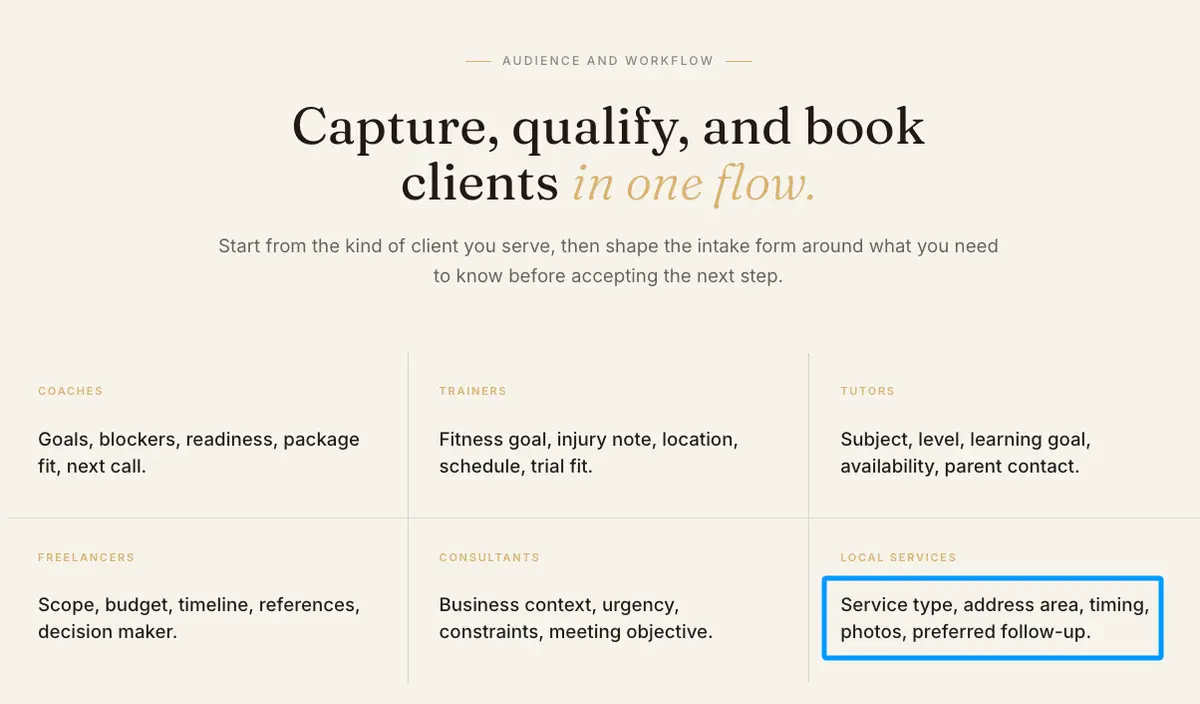
Keep the form light. A seller inquiry may need an address, timing, and contact preference. A buyer inquiry may need a target area and approximate timeline. Ask only for what changes your first response; everything else can wait until the conversation.
No full website needed. The broker bio and inquiry route can live together on one focused action page.
Risks: unsupported claims and confusing brokerage roles
Broker status adds credibility only when the wording is accurate. Avoid rankings, sales volume, review totals, awards, designations, or “number one” claims that cannot be checked and dated.
For REALTORS®, Article 12 of the 2026 NAR Code of Ethics requires a true picture in advertising, marketing, and other representations. Use the same standard throughout the brokerage profile: qualify numbers, name the source, and remove stale claims.
Reviews need the same care. The FTC’s consumer reviews and testimonials guidance addresses fake, false, and otherwise deceptive review practices. Use genuine feedback with permission and do not turn it into a stronger result than the client described.
Role confusion is quieter, but costly. Do not call someone the managing broker, team lead, listing specialist, or office owner unless that label is current and correct. State where inquiries go. Prospects should know whether they are contacting you, a named team member, or the brokerage intake desk.
A real estate broker bio does not need to carry the whole brokerage on its back. It should show local relevance, make the broker’s role easy to understand, and guide one interested person forward.
Your next move is small: rewrite the broadest claim in your current bio as one verified local detail that points to your consultation path. The experience is already there. The page just needs to show it.
FAQ
Should broker bios mention team members?
Yes, when team members are part of how clients are served, but name the role each person plays and show where the inquiry goes next. A separate team profile is useful when one paragraph would turn into a roll call.
Can a broker bio include multiple service areas?
It can. Group nearby markets in a believable way, then clarify where the brokerage is most active. A list of twelve counties with no context reads like a coverage claim, not local knowledge.
What proof belongs on a broker bio page?
Use proof a prospect can understand and you can verify. Current license information, legitimate designations, years in a defined role, sourced transaction figures, genuine reviews, and specific market experience may all fit. Choose a few. The page still needs room for the next step.
About this content
- Written by
- Mia Anderson, UGC Creator · Content Creator
- Reviewed by
- CueCue Team, Editorial review desk
- Last updated
- July 1, 2026
- Editorial standard
- CueCue articles are written for practical use, checked for clear sourcing, and updated when product or policy details change.