

Hi, I am Mia, and I learned this the frustrating way. I once lost a project to someone with a much simpler portfolio. Her work was good, though not dramatically different from mine. Her page was simply easier to trust. It told people what she did, gave them enough proof, and showed them where to begin.
That lesson follows me whenever I study realtor bio examples. Even a polished biography can leave someone hesitating. A buyer may still wonder whether you really know the area. A seller may not be sure you have handled a situation like theirs before. Strong realtor bio examples clear up that doubt without reading like a cabinet full of awards.
Below, you will find three adaptable examples for established real estate professionals. Each one is built around trust and a visible next step, not inflated claims or generic lines about “making dreams come true.”
What realtor bio examples should help readers decide

A visitor is not reading your biography to memorize your career. They are trying to make a small decision:
Should I keep looking, or should I contact this person?
Your bio should make that decision easier by covering four points:
- Who you help: Start with the people you actually serve. That may be buyers, sellers, investors, relocating families, or a more specific group.
- Where you work: Be clear about your service area. Name the cities, counties, or neighborhoods you know well enough to discuss in detail.
- Why your guidance is credible: Give readers a reason to trust your advice. Verified experience helps, but so can a relevant background, an active designation, or a clearly explained way of working.
- What happens next: a consultation, home valuation request, relocation conversation, or property search.
Keep the proof proportional. A verified sales figure may help, but a specific process can also build trust. “I send a written update every Friday” is more useful than “I provide exceptional service.” Tiny detail. Big difference.
For NAR members, public marketing should present a “true picture,” as described in the 2026 NAR Code of Ethics. That is a good editing standard even beyond formal compliance: every number, award, testimonial, and specialty should be supportable.
Realtor bio examples by positioning
These are sample realtor bio templates, not claims to copy word for word. Replace every bracketed detail with something accurate. Remove anything you cannot verify.
Local guide
Jordan Lee helps buyers and sellers make confident moves across [City] and the surrounding [neighborhoods or county]. After [verified number] years working in the area, Jordan has learned that local knowledge is rarely one dramatic fact. It is knowing how commute patterns change by street, which home features matter in different price ranges, and when a property needs a closer second look.
Jordan keeps clients informed without burying them in updates. He brings useful local context into each decision and adjusts the process when a client’s timing changes. His work focuses on [specific client type or property type] through [brokerage].
Planning a move in [service area]? Request a short neighborhood consultation to talk through your priorities.

Why it works: The bio earns the “local” position through concrete knowledge rather than saying “local expert” five times. It also names the client, geography, and next conversation.
Make it yours: Add one or two details you regularly explain to clients, such as transit tradeoffs, housing stock, seasonal inventory, or neighborhood boundaries. Stay factual. Avoid language suggesting that certain kinds of people belong in particular areas.
The Fair Housing Act overview from HUD is a useful reference when reviewing public-facing housing language. State and local requirements may add further rules, so run final copy through your broker or compliance contact.
Relocation specialist
Priya Shah helps professionals and families relocate to [Metro Area] with fewer unknowns between the job offer and move-in day. Her process begins with the practical questions: preferred commute, housing type, timing, budget, and what clients need nearby.
Before showings begin, Priya helps clients compare areas, understand the buying timeline, and prepare a focused property search. She also helps clients relocating from [regions you genuinely serve]. When needed, she works alongside [verified partners or brokerage resources] to keep the move organized.
Planning a move to [Metro Area] within the next [time frame]? Send over your target date and the few things you will not compromise on. That gives Priya enough information to suggest a useful place to start.
Why it works: Relocating buyers rarely arrive with one neat question. They are usually trying to sort out work, timing, neighborhoods, housing costs, and the move itself all at once. This real estate biography example reduces that fog by explaining the first part of the process.
Make it yours: Mention the logistical questions you routinely handle. Do not claim a national network, relocation certification, language skill, or employer partnership unless it is current and documented.
Listing-focused realtor
Marcus Green works with homeowners preparing to sell in [service area], with a focus on pricing decisions, presentation, and a well-organized launch. His listing process starts with the property and the seller’s priorities, then moves into a written plan for preparation, marketing, showing communication, and offer review.
Marcus has experience with [verified property type, neighborhood, or seller situation]. Sellers receive direct guidance on what may be worth addressing before launch and what can stay exactly as it is.
Considering a sale in the next [time frame]? Request a property planning conversation before making a renovation or pricing decision.
Why it works: This sample realtor bio describes the working method. It does not depend on a giant sales number to sound capable.
Make it yours: Add verified sales volume, list-to-sale metrics, awards, or review excerpts only when the source and time period are clear.
The FTC’s consumer reviews and testimonials guidance addresses fake, false, and deceptive review practices. Use real client language with permission, preserve its meaning, and never create a review to fill an empty section.
How to add a stronger CTA after the bio
Your biography explains why someone might trust you. The CTA tells that trust where to go.
Choose one action that matches the bio’s position:
- A local guide can offer a neighborhood consultation.
- A relocation specialist can collect a move date, work location, and housing priorities.
- A listing-focused realtor can invite a property planning or valuation request.
One action is enough. Really.
I learned this on my own portfolio after cramming too many paths onto one page. I eventually rewrote the page so it named the people I helped and put one useful action near the top. After that, the next step no longer needed an explanation.
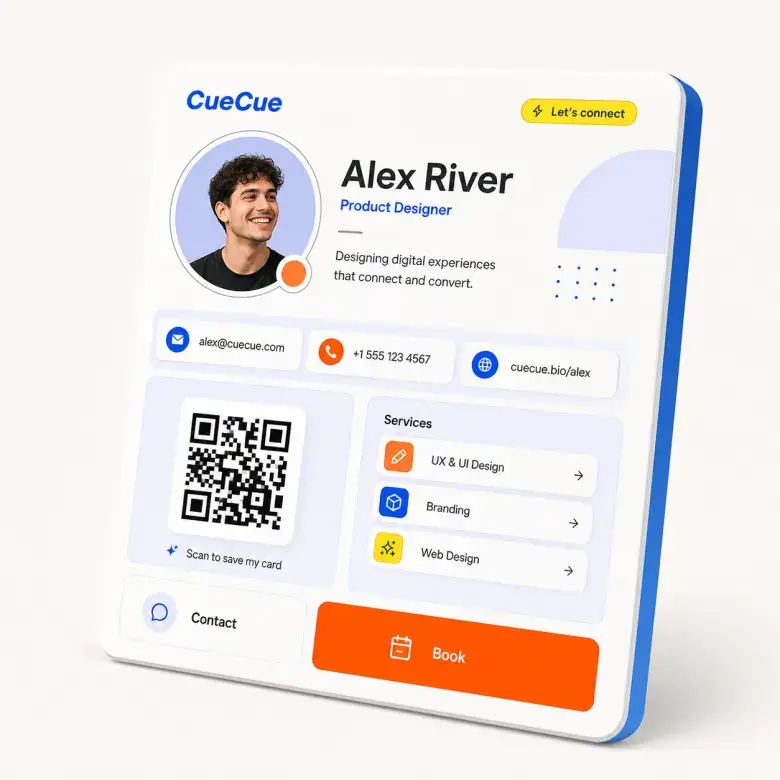
A digital business card gives people one place to find the details they actually need. They can read your bio, confirm your brokerage, view your listings, and choose how to contact you. The same card can be shared after an open house, added to an email signature, sent with a referral, or opened from a QR code.
A name and email address will not tell you much about every potential client. For more detailed inquiries, your main button can open a short intake form. Ask only for the information that will help you give a useful first reply. A realtor version might ask about target area, property type, timeline, current representation, and preferred follow-up. The goal is not to interrogate the visitor. It is to make the first response more useful.
Risks in realtor bio examples: copied language, weak proof, and vague service areas
Copied language is easy to spot because it could describe anyone. Phrases such as “dedicated professional,” “trusted advisor,” and “client-first service” need evidence beside them or they simply float.
Weak proof creates a different problem. A bio may include impressive-sounding figures with no date range, market, role, or source. Before publishing any sales number, review count, ranking, award, or designation, confirm:
- the figure is accurate and current;
- your personal role is represented correctly;
- the organization or source can be named;
- your brokerage and local rules permit the wording.
Vague service areas also weaken trust. “Serving the entire region” may sound broad, yet it tells a prospect very little. Name the places where you actively work and can provide useful guidance.
One terminology note matters too. REALTOR® is an NAR membership mark, not a generic synonym for every licensed real estate agent. Members can review NAR’s logo and trademark rules for correct public use.
The realtor bio examples above are starting structures. Your one move today is to choose the positioning that matches your actual business, replace every bracket with verified detail, and finish with one inquiry action.
FAQ
Can realtors use the same bio everywhere?
Use the same core positioning, then adjust the length and CTA for the platform. Your brokerage profile may support a fuller biography. Instagram needs a compact promise and link. A digital card can hold the complete version plus contact and inquiry actions.
Keep facts consistent across every version. If your service area or designation changes, update the smaller profiles too.
Should realtor bios include sales numbers?
They can, when the numbers are verified, relevant, current, and allowed by your brokerage and local rules. Give the number enough context to mean something. State the time period and market, explain which property types it covers, and make it clear whether the result belongs to you personally, your team, or the wider brokerage.
No reliable number yet? Use proof from your process, experience, certifications, market focus, or communication standards instead.
How can realtors make examples sound personal?
Start by deleting any sentence another agent could paste unchanged. Generic lines are usually the easiest ones to remove. Replace them with a detail drawn from your real work. You might explain who you usually help, describe the kinds of properties you know well, or say how clients hear from you during the process. Even the first question you ask in an initial consultation can make the bio feel more like yours.
Read the bio aloud. Awkward phrases reveal themselves fast. Start there.
About this content
- Written by
- Mia Anderson, UGC Creator · Content Creator
- Reviewed by
- CueCue Team, Editorial review desk
- Last updated
- July 1, 2026
- Editorial standard
- CueCue articles are written for practical use, checked for clear sourcing, and updated when product or policy details change.